A tonne of steel structure earns just RMB 344
In 2025, China's fabricated steel output reached 107 million tonnes, the fourth year above the 100-million mark; the industry's total output value was RMB 1.158 trillion. The numbers look impressive; the margins do not.
Honglu Steel, the sector leader, reported 2025 revenue of RMB 22.068 billion, up only 2.57% year on year; net profit attributable to shareholders was RMB 631 million, down 18.27%; gross profit per tonne was RMB 344, RMB 50 less than the year before. This is why so many fabricators suddenly got serious about exports this year — not out of sentiment, but because the math no longer works.
The export data confirms it: sampled enterprises in the China Steel Structure Association exported 4.0248 million tonnes in 2025, up 73% year on year. But the average export price fell to RMB 10,463 per tonne, year after year. More volume, lower price — proof that most are still selling components, not solutions.
October 10, Huizhou, seven trucks
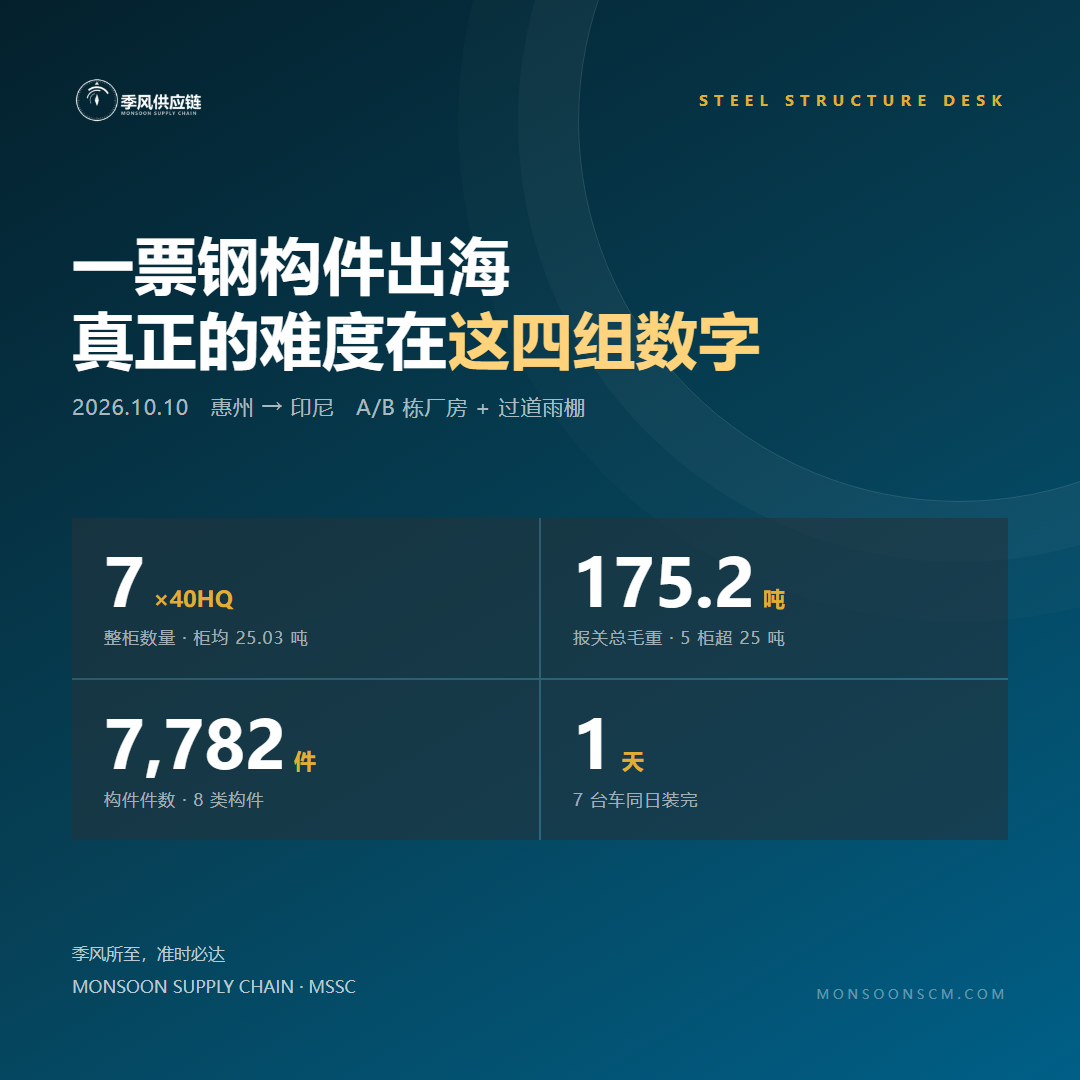
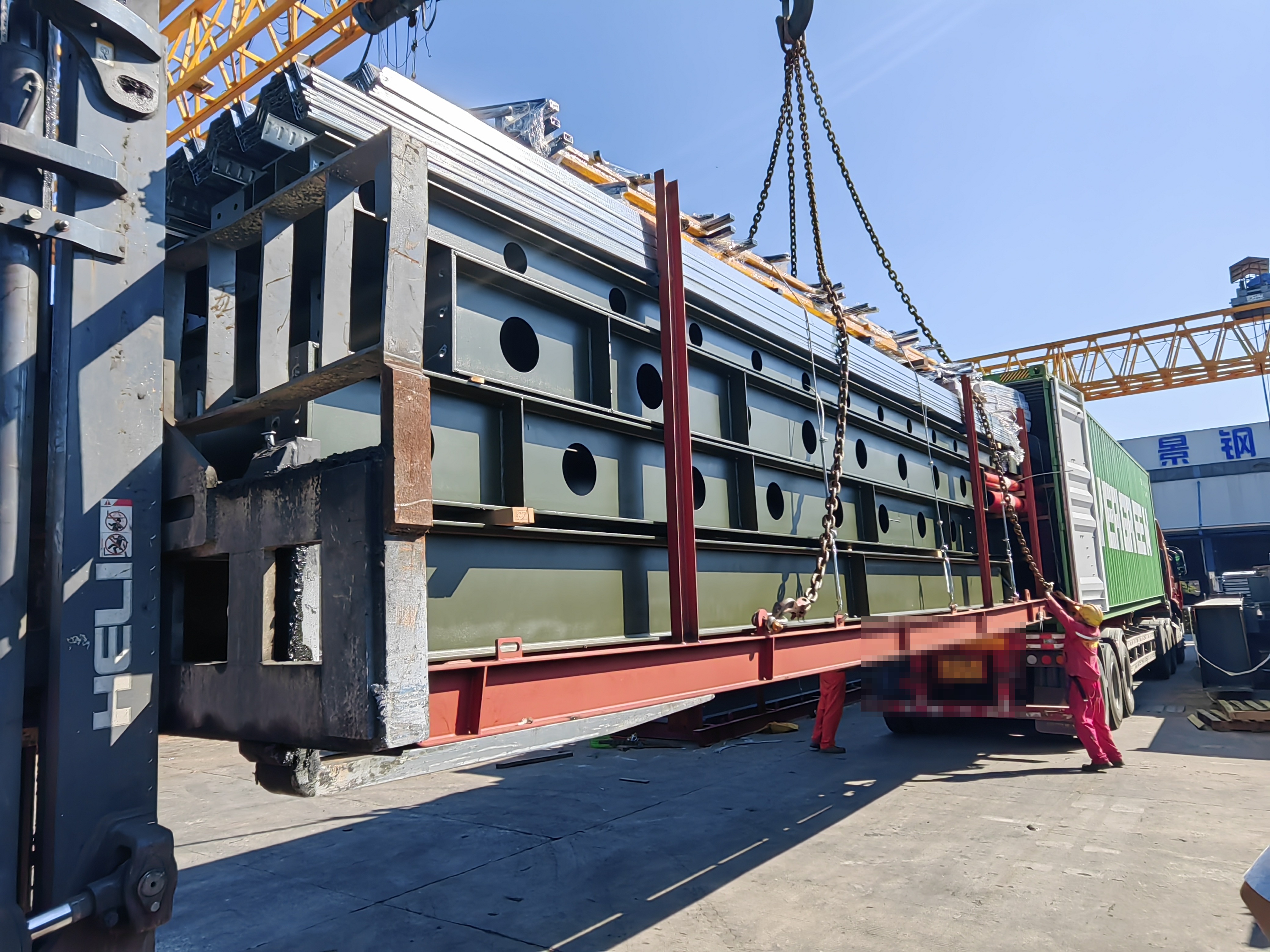
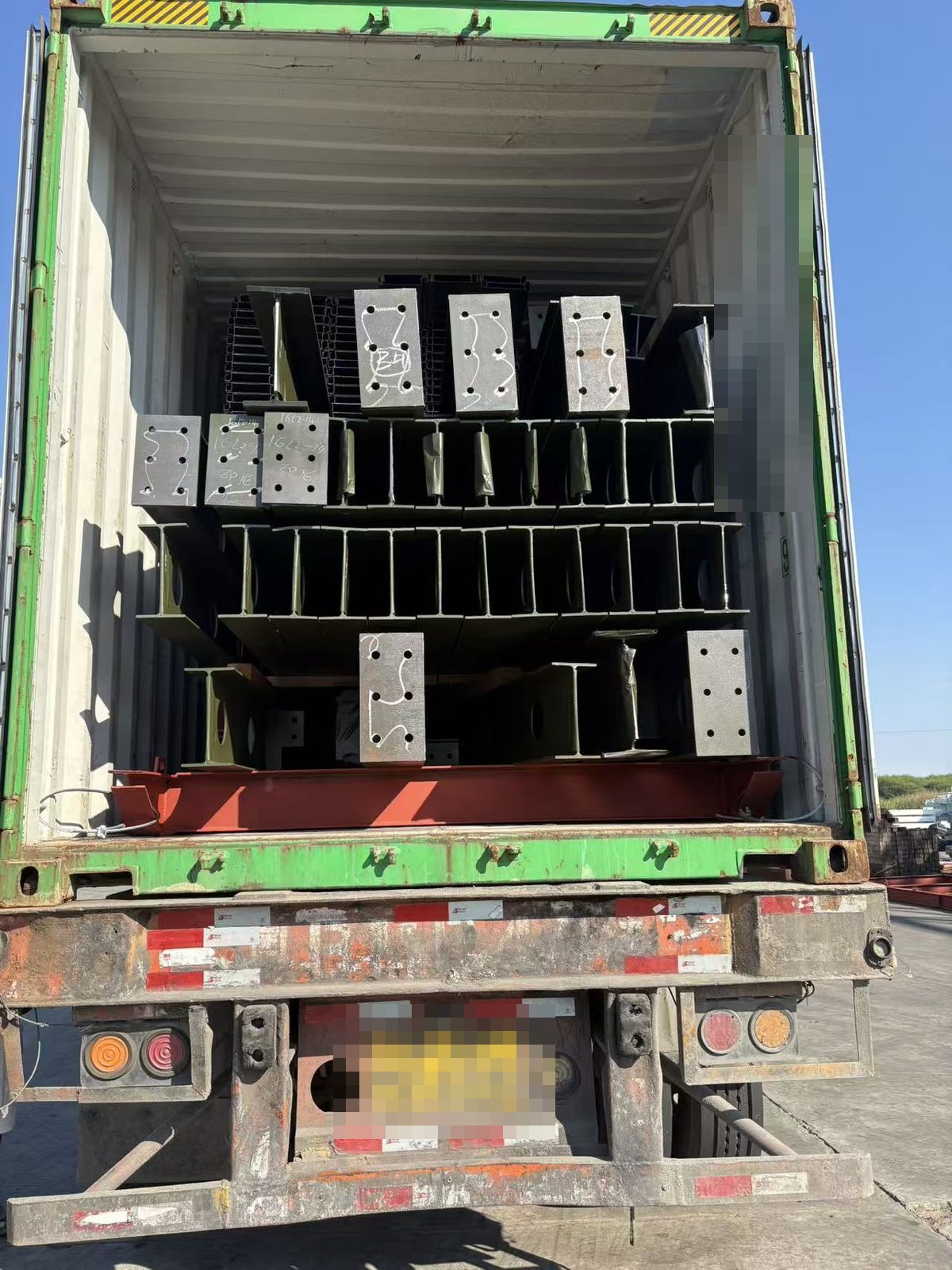
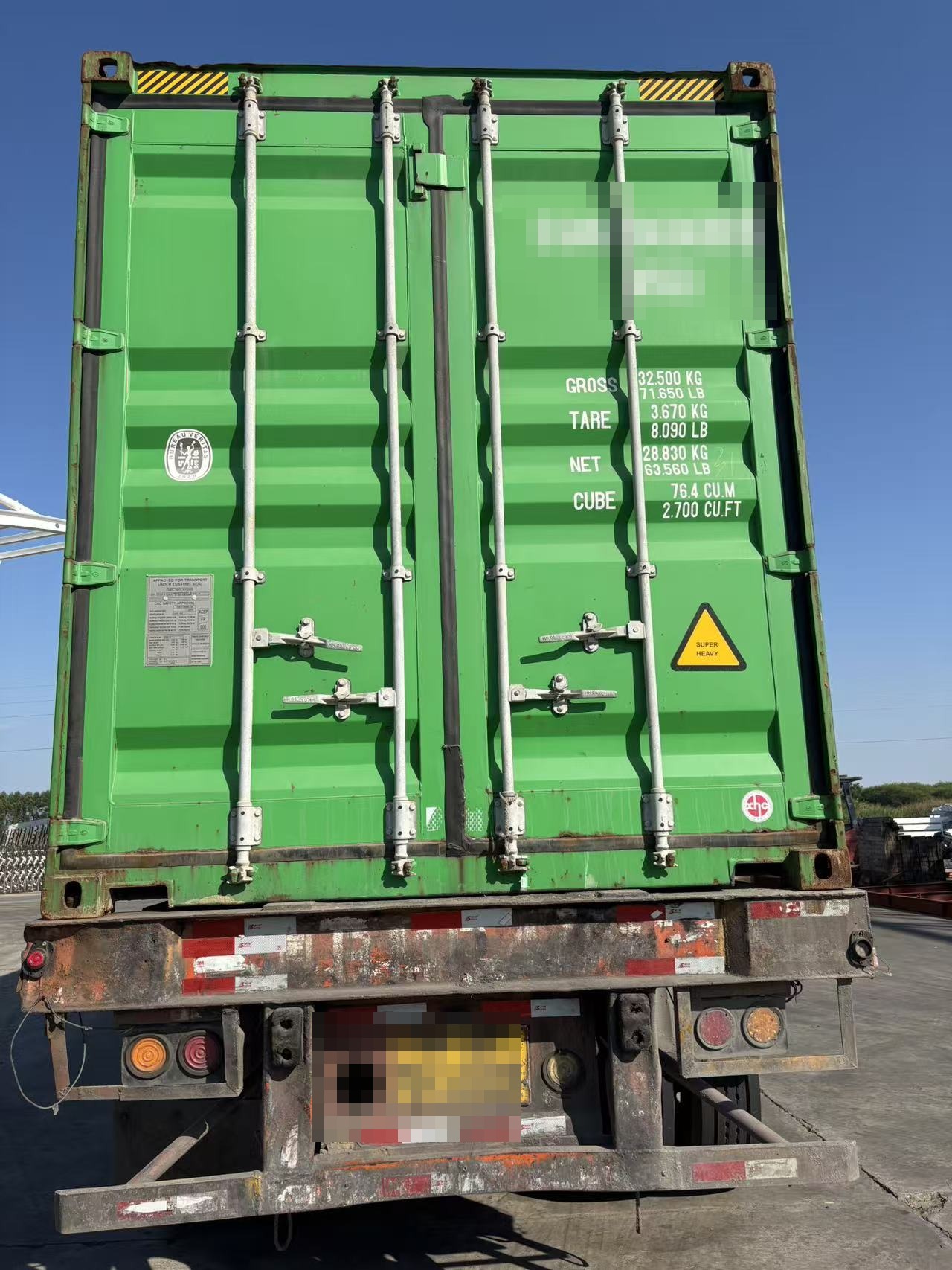
Three red tractors with Guangdong B plates, each pulling a 40-foot high-cube container, seals locked in advance. By evening, all seven trucks were loaded: 7 containers, 7,782 pieces, 175.2 tonnes, finished in a single day.
This was a shipment to a factory building (Blocks A and B) plus canopy walkway in Indonesia. The customer is a steel fabrication enterprise in Huizhou.
Heavy: average 25.03 tonnes per container, five containers sitting on the 40HQ load limit. Long: the longest member is 10 metres, galvanised decking. Scattered: of the 7,782 pieces, 2,475 are connection plates weighing 0.2 to 22 kg. Mixed: two materials, B355B and Q235B, eight categories of components, one customs declaration.
The day had no drama. No container imbalance, every timber spacer carried the IPPC mark, component codes and shipping marks were affixed before loading, five documents consistent, customs cleared on the first attempt. But in this industry, no drama is itself something that has to be designed for.
Steel components are not heavy cargo — they are project cargo
Forwarders habitually file steel components under heavy cargo and quote by the tonne. That classification is wrong from the first step. The cargo carries five conflicting attributes at once: heavy, long, scattered, rough, and expensive at the back end.
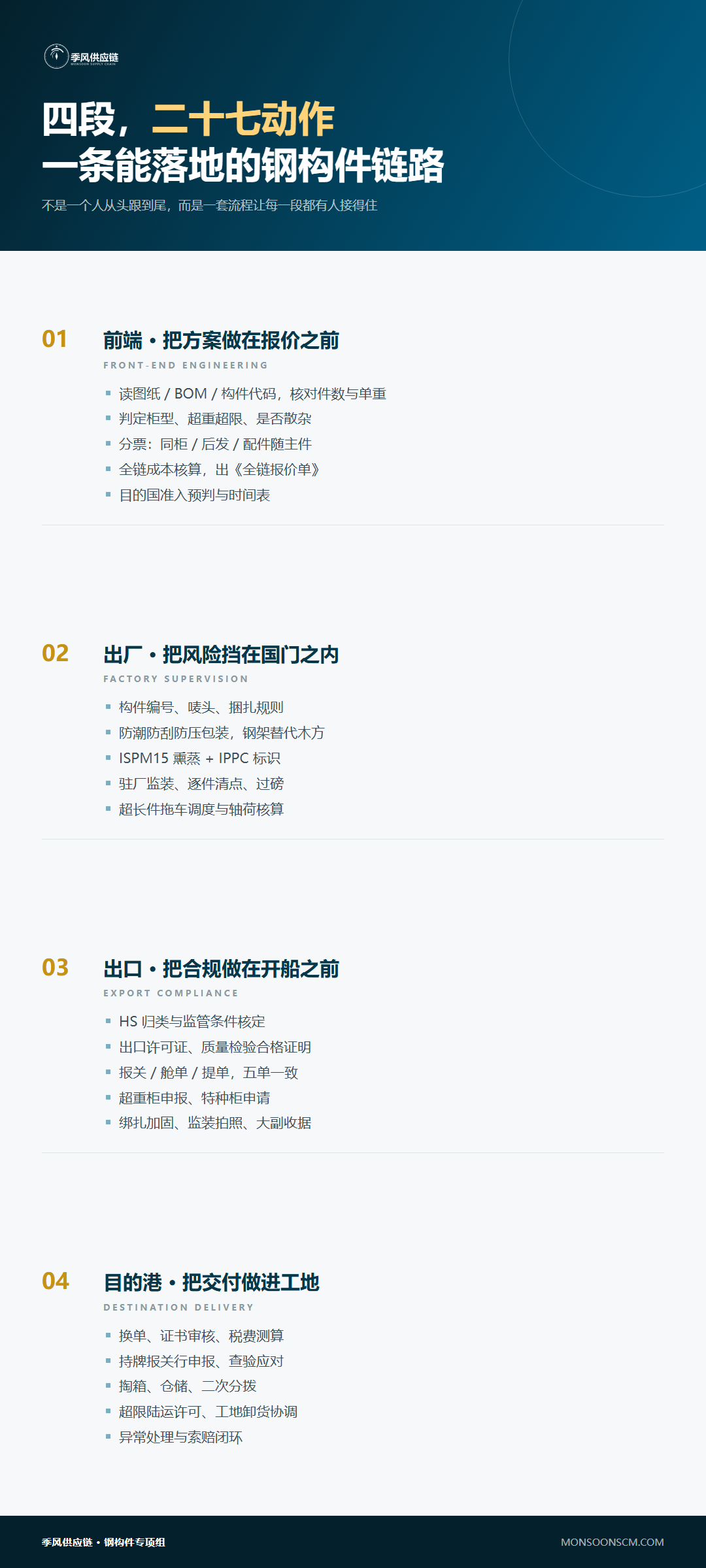
We break one shipment, from contract to site, into nine gates: drawings and BOM, container type and loading, packing and securing, export customs, space and schedule, loading and lashing, destination clearance, devanning and delivery, sign-off and exceptions.
Ordinary forwarders usually handle only two gates — customs and booking — leaving the other seven to the customer. That is the real reason freight looks cheap but the total bill is expensive: what you saved comes back all at once on arrival, as demurrage, amendment fees, return freight and site downtime.
Monsoon's approach: turn luck into process
Monsoon's steel-component programme did not open a new lane. It broke the nine gates into four stages and twenty-seven actions, each with an owner, a deadline and a deliverable.
The single most important rule: a steel-component quote must be to-the-site, never to-the-port. Quoting only ocean freight leaves the most expensive part for the customer to discover alone; once they step on it, they never come back.
We commit to four things: respond within 4 hours and quote the full chain within 24; push six milestones proactively (booking, loading, sailing, arrival, clearance, delivery); provide a loading diagram and supervision photos for every shipment; and quote to-the-site, with ocean freight, origin, packing, destination and compliance all on one sheet.
Compliance is the real moat today
In 2026, the barrier to steel export has shifted from freight to rules. On the China side, from 1 January 2026, 300 steel HS codes returned to export-licence management for the first time in 16 years. At destination, Indonesia's SNI dual certification takes 3–4 months, Saudi Arabia's SABER is applied for by the importer, the Philippines' PS requires factory audit, and Malaysia mandates EPD for long steel. The EU's CBAM starts charging in substance in January 2026, possibly adding RMB 130–4,670 per tonne of steel by the default-value method; the US Section 232 and EU quotas have largely closed the transshipment route.
Together, these four shifts mean one thing: steel export is no longer about getting the cargo out, but about doing the compliance work up front.